※Permission to post this was given by the artist. Please contact the artist for further use of the artwork. If you liked this fanart, you can give it a rating and view the artist’s other works via the provided link.
If you’re on the internet, and you’re a weeb like me, chances are, you may have heard of Touhou! The series is quite prolific in the Japanese and western communities, having over 2 million art submissions on Pixiv alone, numerous fan-anime, thousands of music remixes, loads of fangames and thousands of videos.
What is it?
At its core, the Touhou Project is a series of danmaku (bullet hell) shooting games, playing like a classic arcade vertical scroller. Players are required to play through various stages of enemies that shoot huge amounts of slow-moving projectiles across the screen, while dodging them. There are currently 16 main games in the series, the first 5 of which were released in the late 90′s and were for the old Japanese PC-98 computer system, and the most recent 11 of which are for Windows.
Each main game in the series was developed by a single man – Jun’ya Oota, going by the alias ZUN, publishing under the company name Team Shanghai Alice. He does all of the game’s programming, music, story and character design by himself, releasing them at conventions like Comiket and Reitaisai – a yearly Japanese Touhou convention.
Aside from each of the main games, there are also spin-off games, which often feature different mechanics. Some of them are also bullet hell games, but with different gameplay mechanics, while there are also five official fighting games, developed in partnership with Tasofro (Twilight Frontier), a doujin game developer circle.
Aside from the games, there are also many print works – consiting of artbooks, several official manga, text-based books and an official magazine. These are all canon, and further expand the universe and characters developed in the games.
And finally, the last bit of official material in the Touhou series are ZUN’s music CDs – releases of music in the game’s characteristic style, usually accompanied by a side-story.
And that is all the material that is considered the Touhou project! Any anime you may have seen are fan-made, and while many are really well done, there is no official Touhou anime.
The story
The Touhou Project majorly revolves around Gensokyo – a sealed-off, magical region of japan where humans live alongside a huge variety of youkai (Japanese mythological creatures), ancient beings, gods, magicians, fairies, ghosts, vampires, famous historical figures, immortals, hermits, you name it! The catch is that, rather than appearing monstrous, nearly every character in the series is a personification. A female personification. A cute female personification. And, by some miracle, every single character manages to be completely tasteful and unique.
(This isn’t even the full cast.)
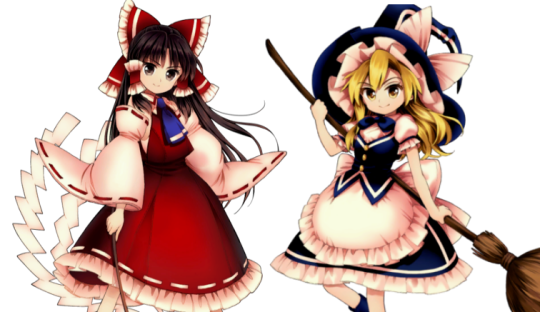
The series’ protagonists are Reimu Hakurei and Marisa Kirisame, a human shrine maiden and human magician, who, occasionally with the help of friends, must go out and fight to protect Gensokyo when one of its powerful inhabitants decides to do something that threatens the balance. Reimu, strong-willed and short-tempered, is the latest member of the Hakurei line, shrine maidens who have historically been the protectors of Gensokyo. Marisa is a cheerful, reckless witch and thief who uses powerful light-based magic and fights for loot and thrill. They feature as playable characters in nearly every game, and feature prominently in the print works.
In Touhou, the bullet hell genre is actually part of the canon. Characters fight using the Spell Card system – battles in which participants duel with Spell Cards – different complex attack patterns that the other combatant much dodge, which seem to take the form of actual cards, which, when activated, unleash a magical attack. This style of fighting is non-fatal, and mostly non-damaging, relying more on skill and beauty than overpowering an opponent directly. This system was established by Reimu herself, so that youkai and humans could settle their issues without unnecessary injury.
Each game adds a new group of characters to the Touhou universe, although not all of the villains are pure evil. Many of the incidents that occur in Gensokyo threaten life on a large scale, but an equal many are mostly inconsequential. In the same series, you have a game where an annoyed vampire blocks out the sun simply so she can go outside without needing a parasol, and a game where a youkai from Hell who has recently gained the power of nuclear fusion threatens to burn the entire surface world to the ground. But by the end of each game, the new characters usually end up settling down and integrating themselves into Gensokyo, which gradually builds up a huge cast of a characters and a very dynamic, exciting universe.
And of course, an interesting universe is going to spawn dozens upon dozens upon hundreds of fan content, videos, music, memes, and more.
The music
In the Touhou games, every stage has its own theme, and every boss has its own theme. Touhou music is generally regarded to be very good, and has spawned a huge amount of fan arrangements and albums. Here is an example of some of the official music!
I’d encourage you to listen to different songs from different games, because everybody has different tastes. There’s a ton!
Wow, that’s a lot of stuff. How do I get into it all?
Touhou games are hard. Really hard. While they’re easier compared to other bullet hell games, the bullet hell genre in general has a huge learning curve. The majority of people who are into Touhou probably can’t beat any of the games. I can’t. So chances are, you aren’t going to learn the story of Touhou through playing the games, although I would still urge you to try to play them, since they can be very fun once you get the hang of it! They’re unavailable outside Japan, although if you don’t want to buy them, finding a download link shouldn’t be hard.
I doubt most people who enjoy Touhou enjoy it purely because of the games – it has a huge universe with 100+ interesting characters, and that is most likely where the appeal comes from. So I encourage you to do your own research to try and find out more!
Obviously, with so many games and so many characters, it becomes difficult to cover it all in one post, so I would recommend Touhou Wiki! On the main page, there are links to every official game, print work, and music CD, where you can learn more about the story of each. Each official game’s article has subsections detailing the story, providing the game’s translated dialogue, and listing the music and characters in each game. This page offers a list of every character, and each page is pretty comprehensive!
Once you’re acquainted with the story and characters, you could try to play the games or find gameplay videos, but as long as you’ve read the stories, you’ll probably understand the plots and characters.
The print works are also a big part of Touhou’s story, second only to the games. I’ve listed the most important ones to read in this post, but encourage you to read all of them if you’re interested! They offer a lot more information on the universe and are really fun.
The music CDs mostly revolve around Maribel Hearn and Renko Usami – two characters who currently live in the future, in the world outside Gensokyo, and provide commentary on the state of the world, while also exploring Maribel’s odd, developing ability. However, these stories are short, and are less relevant to Gensokyo, and so the music CD stories only offer a very small slice of canon compared to the games and print works.
And that’s really all there is to it, in terms of official material. Other than that, you’re free to enjoy Touhou at your leisure! Part of it is the official works, but a huge part is also fanworks! There are tons of fan-made games, music remixes (just search up on Youtube, you’ll find a ton), doujins (many of which are translated on Danbooru), and even a few fan-made anime. I would personally recommend Memories of Phantasm, a fantastic anime exploring the events of the games that stays very true to the story and would be good for someone getting into the series.
It takes a while to really get to know everything, but you’ll never run out of Touhou content to enjoy, and it has a bit of everything for everyone! The fanbase is usually quite accepting and helpful, so whether you’re here to stay or just checking it out, I wish you luck and hope you can enjoy it!
– almost all of his characters he’s created are female
– none of their outfits are sexualized
– creates every aspect of all of his games himself
– is a musical genius
– relatable (reclusive, doesn’t know how deep the lore of his games are until he starts compiling it all)
– I’ve never heard anyone call him problematic tbh??? Zun did nothing wrong





 well i guess this is it